 How can we actually fight global warming? Of course this is an oft-discussed issue, but how does it actually relate to my previous post, how can and how do anthropologists confront global warming? There was a period where many environmental activists argued that indigenous cultures, in their "traditional" state, were, across the board, environmently friendly. This perception has been thoroughly debunked by environmental scientists and anthropologists alike (for example the Yanamamo of Brazil and Venezuela and indigenous groups living in the Amazon). Currently, it seems, many anthropologists, through their ethnographic work, are focusing on studying how these greater geopolitical, environmental, and economic forces are affecting individual cultures.
But beyond analyzing "others", anthropological theories can be applied to analyze ourselves: what ideologies, what discourses, are at play in this great ecological debate in the United States and between global elites? What are the power relations between the various groups that have arisen and what are they trying to achieve? A simplistic way of breaking this situation down, would be to present it as a binary opposition, the great, powerful conservative forces of the rich vs. the underpriveleged, underrepresented masses. Of course, at least for the short-term, maintaining the status-quo of energy consumption is in the best interest of oil companies. This is, basically, not in the best interest of planet earth, and the vast majority of its inhabitants. But, obviously, the situation is more complicated than that. We are not necessarily broken into two, continuously opposing groups. Power is diffuse, divided between various groups, individuals, agents, if you will. For example, the United States government, Congress, individual congressmen, are all agents, working individually, but simultaneously together, within the limits of their cultural perceptions, and the socio-economic structures (i.e. market forces) we collectively abide by. And science, while through its processes paints pictures seemingly close to reality, is a malleable ideology, bent and twisted, limited and influenced by agents, may they be scientists themselves, oil companies, or think tanks. And even the aforementioned "underpriveleged" possess power, through PIRGs, through their ability to vote, through their collective actions. Yet those who are not considered rich are not necessarily driven to "defend" the environment or future generations; we may buy into market principles, believing that the market will correct the problems. Some of us do not believe in global warming, some of us are too afraid or too lazy to make dramatic changes in our lives, and most of us live for the
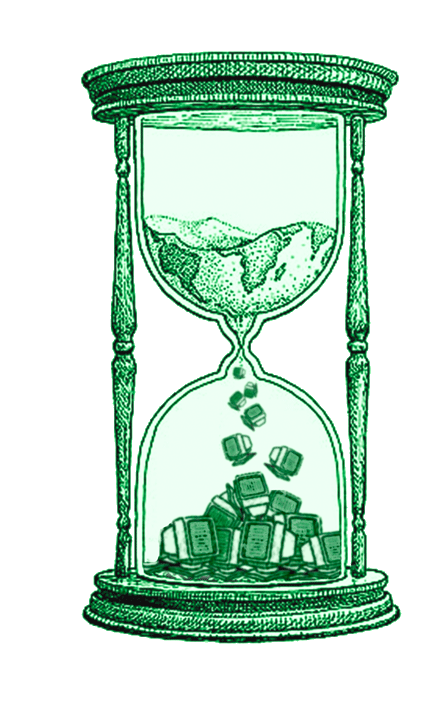 here and now rather than tomorrow. Wendell Berry constantly argues that as a culture, as a society, our greatest flaw is that we ignore limits, we perceive the world as limitless (at least in resources). However, time as a human lifespan is our steepest barrier, time, to an extent, compels us to rush, to complete, to finish, and to "produce" and consume, to, essentially, forgoe much of tomorrow and focus on the here and now. Perhaps it is our cultural perception of time that is damaging rather than the bleak reality of human life. Perhaps it is our faith and dependence on science and the "free market"that is so deleterious. Our culture instills science with great value and, somewhat ironically, faith. The scientific process, we hear, can slow global warming. New technologies, biofuels derived not from corn, but from algae or cellulose compounds, wind energy, improved solar panels, hybrid cars, etc. can stop us from blindly consuming these limited resources. When, if ever, these products reach the market place, the trend will be reversed. Of course, the government can expedite these developments by providing funding, subsidies and the like, and, as we have seen, these efforts will be faced with staunch opposition.
How can I sum this up? Anthropology is notorious for sitting on the fence, for rarely taking a strong stance or a steadfast opinion. So, I will attempt to make one right here. Cultural and economic change comes slow. Individuals, agents, fight actively to generate change. If we abide by the market, then, we will most likely have to wait a generation. The damage, of course, has already been done; even if we immediately cease the way we live today, the ice caps will continue to melt for the next thirty years or so. The earth, too, takes time to heal. As for me, I'm becoming Amish.


No comments:
Post a Comment